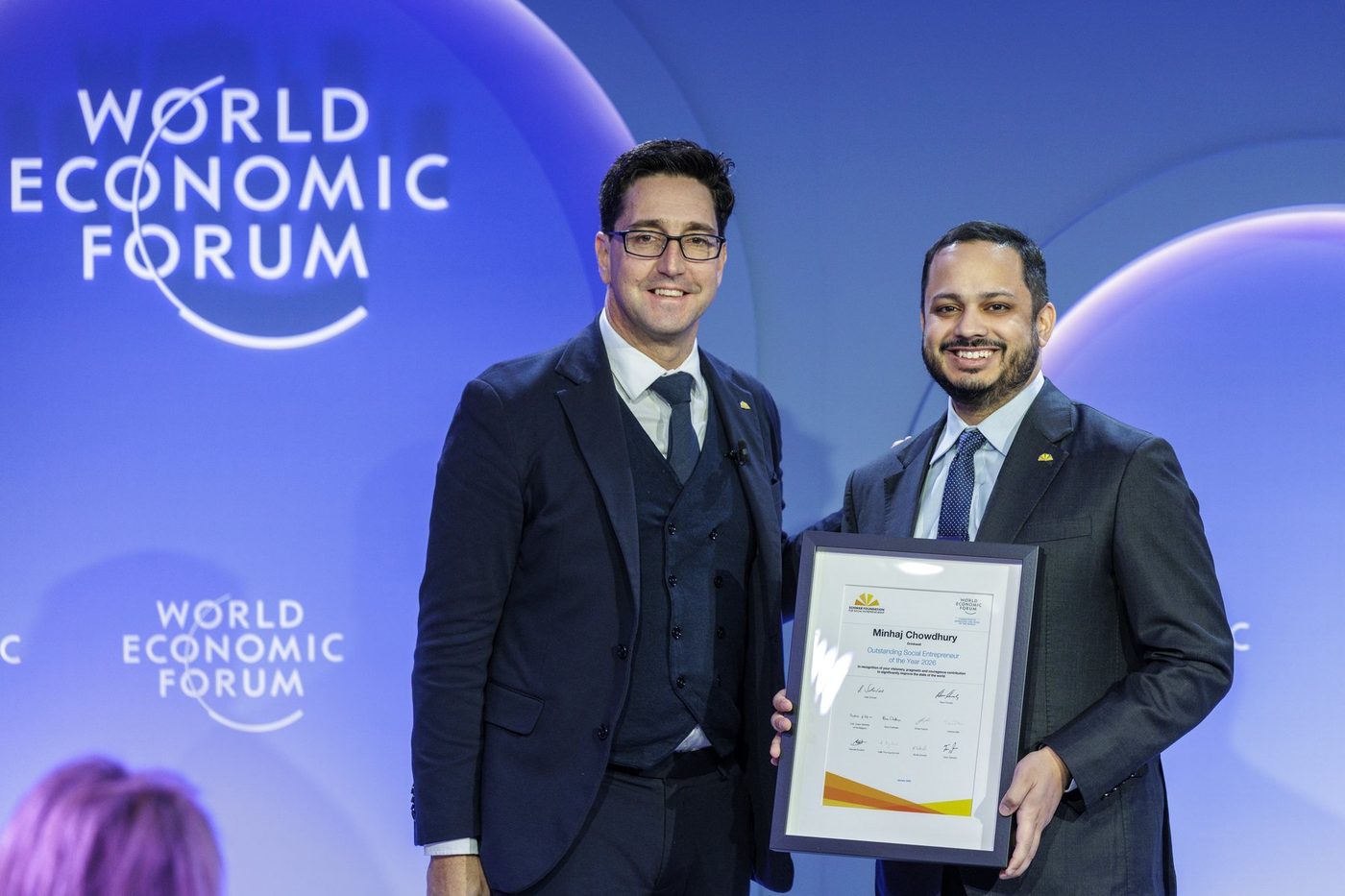
First meeting at Gap Inc.San Francisco, after Drinkwell received the US Secretary of State's Award for Corporate Excellence.
2023
World Economic Forum · Davos · 20 January 2026
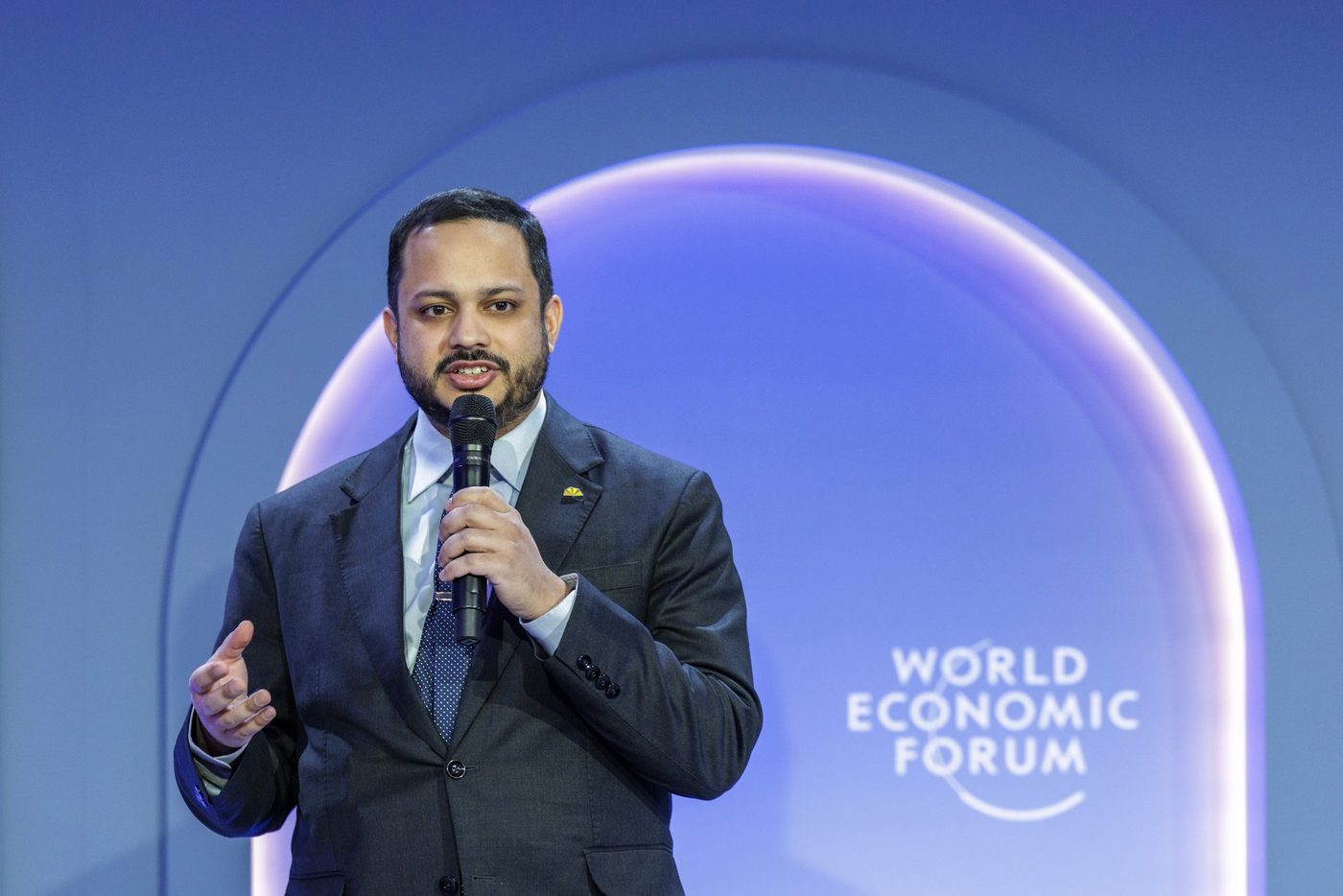
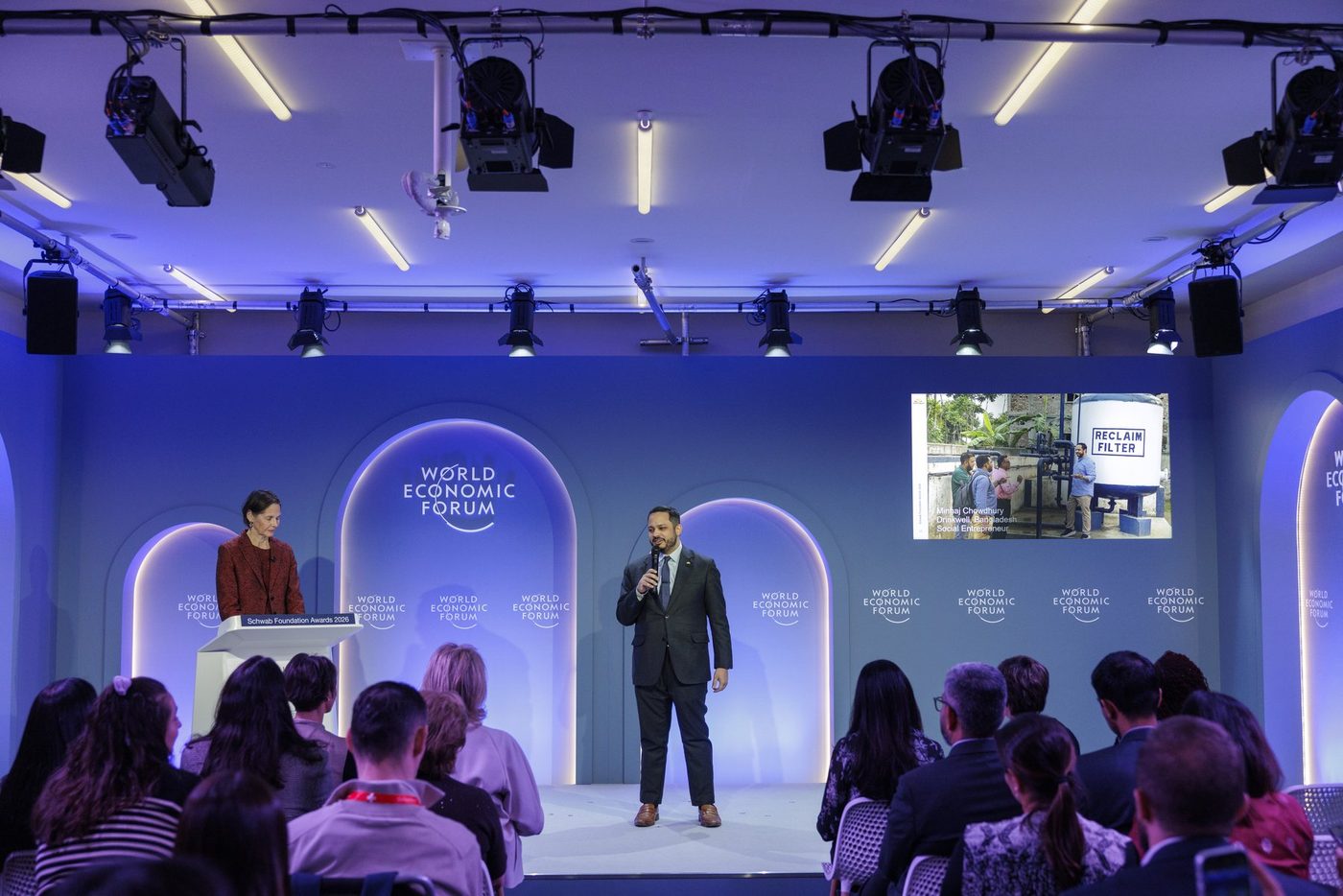
At the World Economic Forum Annual Meeting in Davos, the Schwab Foundation for Social Entrepreneurship named Drinkwell co-founder and CEO Minhaj Chowdhury a 2026 Social Entrepreneur of the Year. The certificate has one name on it. The work it recognises has thousands: the operators, engineers, utilities, districts, funders and families who keep safe water running every day in Bangladesh and India.
The honour
The Schwab Foundation for Social Entrepreneurship is the World Economic Forum's sister foundation for social innovation. Founded in 1998 by Hilde and Klaus Schwab, it has spent 27 years finding the world's leading social entrepreneurs and bringing them into the Forum's rooms: the Annual Meeting in Davos, the regional summits, and the working groups where governments and companies set the agenda.
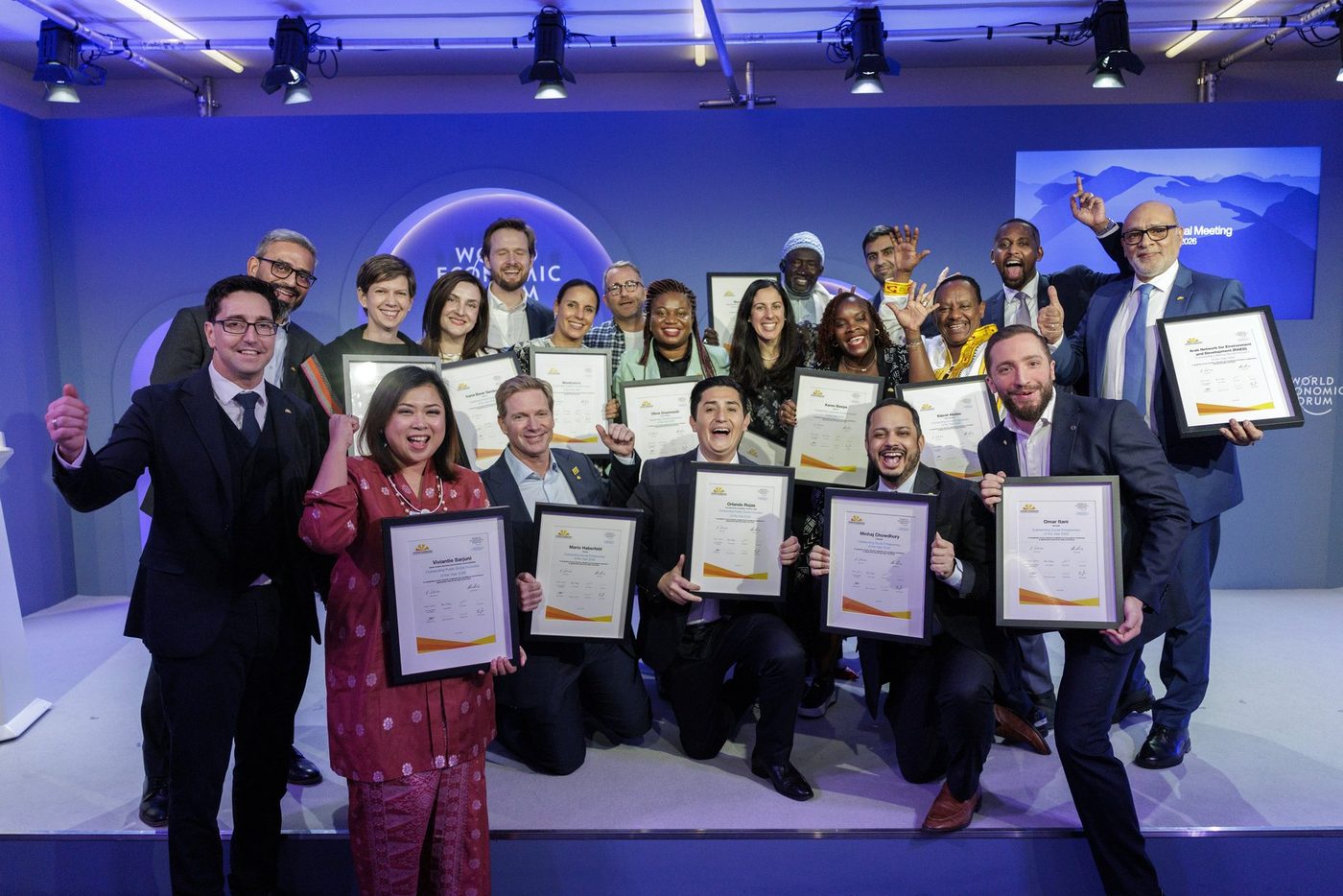
Each January it honours a small class. In 2026 that was 21 leaders from 17 organisations, across four categories: social entrepreneurs, corporate social innovators, public social innovators and collective social innovators. Drinkwell was one of eight social entrepreneurs, the only water organisation in the class, and the only awardee from Bangladesh. The Foundation's citation names Drinkwell for providing safe and affordable drinking water in Bangladesh.
This year's awardees highlight the extraordinary resilience and ingenuity at the heart of our social innovator and entrepreneur community. In the face of unprecedented disruption and uncertainty, these leaders have not only adapted their models but have deepened their commitment to lasting impact.
How it works
There is no cheque. What an awardee receives is access, and a program that turns it into partnerships.
Candidates are selected by the Foundation for transformative solutions to pressing social challenges, on the strength of the model rather than the size of the organisation. The 2026 class was announced on 13 January, a week before the Annual Meeting.
The awards are presented at the Annual Meeting. Awardees hold a full participant badge for the week: the sessions, the bilateral rooms, and a lunch with the Forum's President, Børge Brende. That badge put a water company from Dhaka in the same rooms as the chief executives whose supply chains run through Bangladesh.
Each awardee then joins a focused three-year program: executive education (Minhaj completed the Foundation's Harvard module in April 2026), working groups such as the Forum's AI for Impact workstream, and the regional meetings, from the Sustainable Development Impact Meetings in New York to the Forum's Asia summits.
After three years, awardees become lifelong members of a community of 510 social entrepreneurs and innovators, and of the Rise Ahead Pledge: 28 companies committed to buying from and investing in social enterprises through 2030.
In practice the award is an introduction with the Forum's name behind it. It is the reason a proposal that had been under review for eighteen months was approved ten weeks after Davos.
The ceremony
What it unlocked
Gap Inc. buys from Bangladeshi garment factories, and has a 2030 water goal: improved, equitable access to safe water and sanitation for five million people in the communities its industry touches. Drinkwell had been talking to Gap since 2023, when the two companies met in San Francisco after Drinkwell received the US Secretary of State's Award for Corporate Excellence. A proposal to put Water ATMs in the communities where Gap's suppliers operate went to Gap's water stewardship team in 2024 and was refined through 2025.
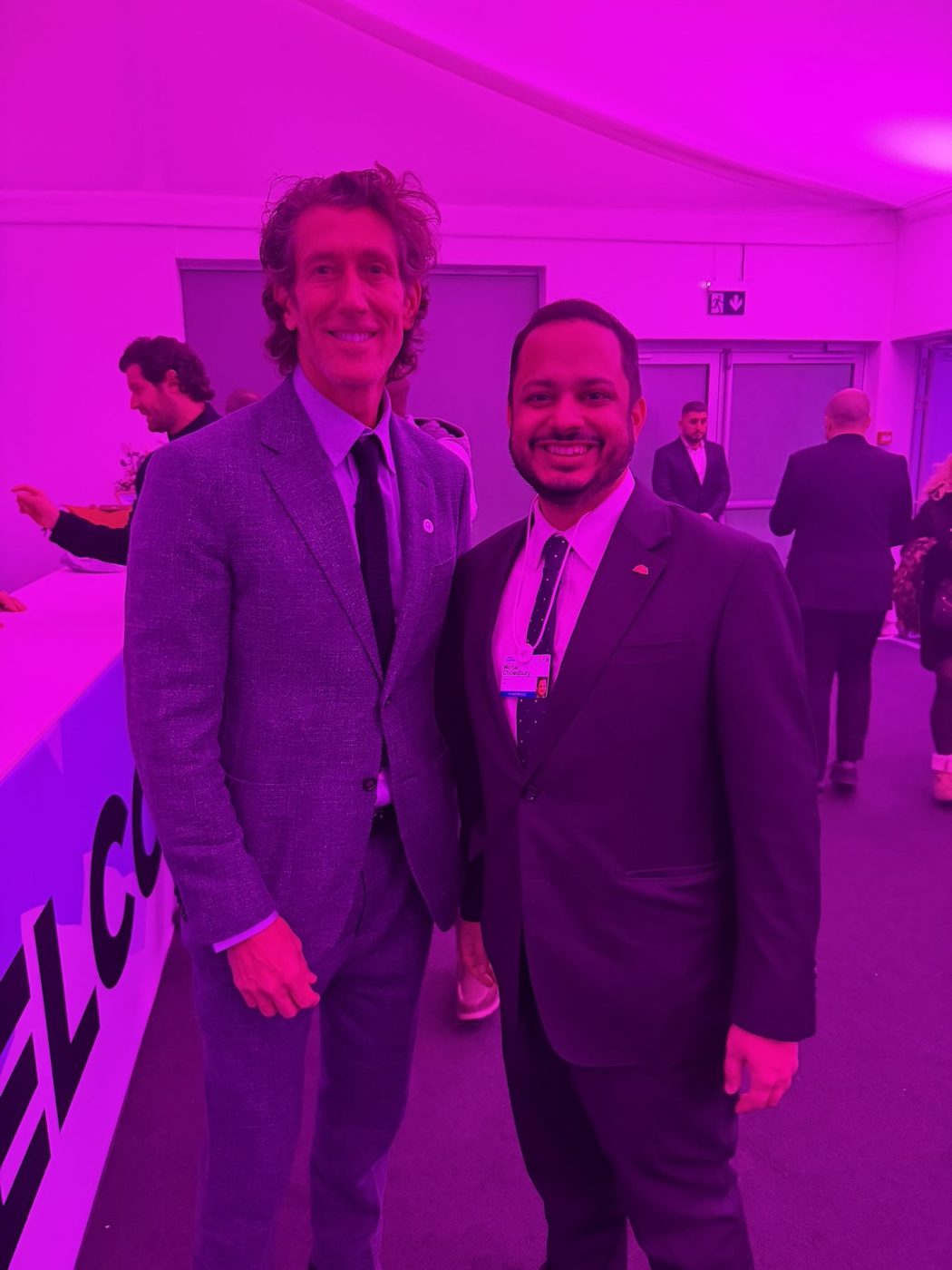
Then came Davos. Dan Fibiger, Gap's Vice President of Global Sustainability and President of the Gap Foundation, asked to attend the award ceremony. Minhaj met Gap Inc. Chief Executive Richard Dickson the next day, and was invited to Gap's headquarters when next in the Bay Area. Five weeks later, on 24 February, Drinkwell presented the partnership at 2 Folsom Street with its San Francisco board member Sanjay Verma. On 6 April 2026, Gap approved it.
The program deploys Water ATMs in Bangladesh, sited in proximity to Gap's manufacturing partners, run on the tariff so that they keep running after the grant, and reported to Gap in litres dispensed and volumetric water benefit. It is a 4-year program, to Gap's 2030 goal. Work began in June 2026.
The partnership in four lines
Bangladesh, in communities around the factories that supply Gap Inc., chosen with Gap's water stewardship team.
Prepaid Water ATMs: metered safe water on a card, operated for a tariff, so the booth pays for its own upkeep after the grant is spent.
Its 2030 goal of improved, equitable access to safe water and sanitation for five million people in communities impacted by its industry.
Litres dispensed and annual volumetric water benefit, reported to Gap; the same meter data that runs the booths.
How the award moved it
Shared
A water company has no solo act. Every litre behind this award passed through a utility's mains, a district's tender, a funder's patience and an operator's hands. So we treated the award as theirs, and marked it with them.
The Water ATM operators and field engineers in Dhaka, Chattogram, Khulna and across Assam, Odisha and West Bengal. They open the booths at dawn and answer the hotline at night. The award is theirs first.
The utilities that chose to put metered safe water on their own mains under a public-private partnership: Dhaka WASA, Chattogram WASA and Khulna WASA, with the city corporations that host the booths.
The Public Health Engineering Departments of West Bengal, Assam and Odisha, and Bangladesh's Department of Public Health Engineering, whose tenders pay for treatment plants that must still work in year ten.
Danone Communities, Imagine H2O, Echoing Green, Rippleworks, the Coca-Cola Foundation, Gap Inc., our lenders and our board. Imagine H2O, a partner since 2015, and Echoing Green both marked the award in their own newsletters.
Twenty fellow awardees, from Tebita Ambulance in Ethiopia to SaveLIFE Foundation in India, who have become collaborators since: on AI for Impact with the Forum, and at Skoll in Oxford in April.
The households in Dhaka's low-income wards and the villages of the arsenic and fluoride belts who chose to pay for safe water by the litre. Their choice, made every morning, is the evidence the Foundation weighed.
If you run a utility, a district, a supply chain or a fund that pays for water infrastructure, we should talk.
Connect with us